The IBioS Collaboratory engages meaningful policy and public outreach strategies that create measurable change and solutions for global biodiversity conservation challenges. Learn more about our work here.
Policy Action Group
Following the Canadian Major Projects Zoom event with Mae Price and Alex Barron, IBioS has created a Policy Action Mailing List for future updates on the major projects and other advocacy needs. Sign up to this mailing list by emailing us at info@ibios.ubc.ca
Read the notes from the Major Projects Event here.

Major Projects Updates
The Federal Government has released a proposal to dismantle key environmental laws to expedite the development of major projects, such as pipelines. They would allow major projects to occur without proper impact assessment and consultation, and may even jeopardises the survival of at-risk species. Stay updated on the major projects here.

Draft BC Biodiversity and Ecosystem Health Framework: Policy Statement
28 UBC signatories acknowledge the Draft British Columbia Ecosystem and Health Framework as a significant opportunity to advance ecosystem protection, improve human well-being, and enhance resilience to climate change. While the framework represents a step in the right direction, the province can go further to increase its impact.

Human-Wildlife Conflict Management at UBC: A case study using bats
This case study examines the university response to the presence of a bat roost in a campus building. The bats species present in the roost have a Blue-list designation by the province due to the new threat of white-nose syndrome in western Canada. This case study serves as an opportunity to examine University response to human-wildlife conflict, and how to best support vulnerable mammal species living on campus through urban development and climate change
Outreach
Listen to our previous Biodiversity Speaks Podcast on Apple Podcasts and Spotify!
Biodiversity Speaks was podcast series by the Interdisciplinary Biodiversity Solutions Collaboratory at the University of British Columbia led by Dr. Helina Jolly where she connects with interdisciplinary scientists to spark conversations on biodiversity conservation. Each episode gives a brief peek into their personal and professional journey, highlighting the biodiversity crisis and their ways of approaching it.
Policy & Outreach Statement
IBioS is dedicated to moving the needle in a positive direction when it comes to facing the loss of biodiversity that is occurring worldwide at an alarming rate. This means employing meaningful policy and public outreach strategies in order to create measurable change, and venturing into the unknown to create solutions for these issues that affect every society across the globe, and, indeed, every organism on Earth.
What this Means To Us
- Translating and communicating science to the public in a meaningful and educational way
- Engaging and empowering communities to improve stewardship and appreciation of the environment
- Building relationships with communities, governments and NGOs in order to protect biodiversity across scales
Objective
IBioS’s emphasis on connecting its work to policy and practice is what will make this work impactful, and allow UBC to become globally-recognized for its work in reducing biodiversity loss and charting a sustainable future for the planet.
Whether finding ways to motivate or require corporations to mitigate impacts on biodiversity along their supply chains, synthesizing evidence for global decision makers to select among alternative conservation policies, or providing farmers with data and analyses to decide whether to adopt a sustainable farming practice, the cluster of faculties working together within IBioS will achieve high impact through its serious attention to scientific translation and outreach, cultivating relationships with policy-makers, and identifying timely opportunities for influencing policies.
The specific activities conducted will be guided by the strategic planning process. These activities could include, among others, hosting workshops and webinars with NGO and government and industry partners; public-facing events like panels or debates on topical issues; developing policy briefs or a monthly online newsletter presenting the cluster’s scientific research and delineating its policy relevance (possibly in partnership with SPPGA and the Global Reporting Centre), and participating in national and global task-forces that can influence policies.
Here, the cluster will build on its existing relationships and partnerships. Cluster members already work with many policy and government organizations from indigenous communities (e.g. Semiahmoo Nation) to international organizations (e.g. IPCC, IPBES, FAO) and have shaped policy at the local, provincial, federal and international levels (e.g., by leveraging events on “Policy in Practice” at UBC to influence recent Canadian policies on plastic pollution and climate change).
In addition to work focused on decision-makers, the IBioS cluster will also provide information to the local public through outreach events, organized in collaboration with the UBC Botanical Garden, UBC Farm, Faculty of Forestry Research Forests, Beaty Biodiversity Museum, and through community engagement projects, such as creating citizen-science programs for monitoring biodiversity, or engaging with communities to promote community restoration and governance of natural habitats.
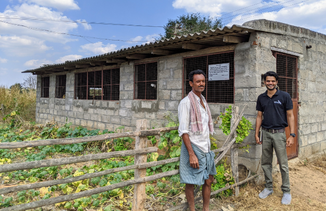
A farmer and a representative of the Centre for Wildlife Studies | Bandipur Tiger Reserve, Karnataka, India. Photo by Sumeet Gulati
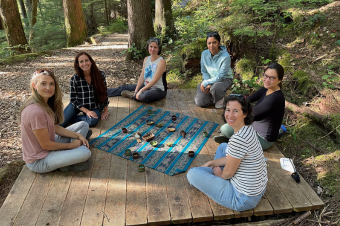
A small group discussion at the 2022 annual IBioS retreat | Loon Lake Retreat Center, British Columbia, Canada. Photo by Claire Kremen.
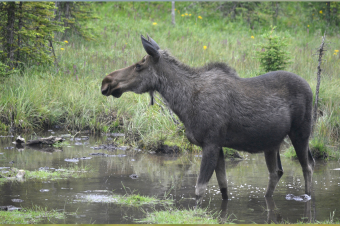
A moose wading through a pond | Kananaskis Country, Alberta, Canada. Photo by Emma Jarek-Simard.